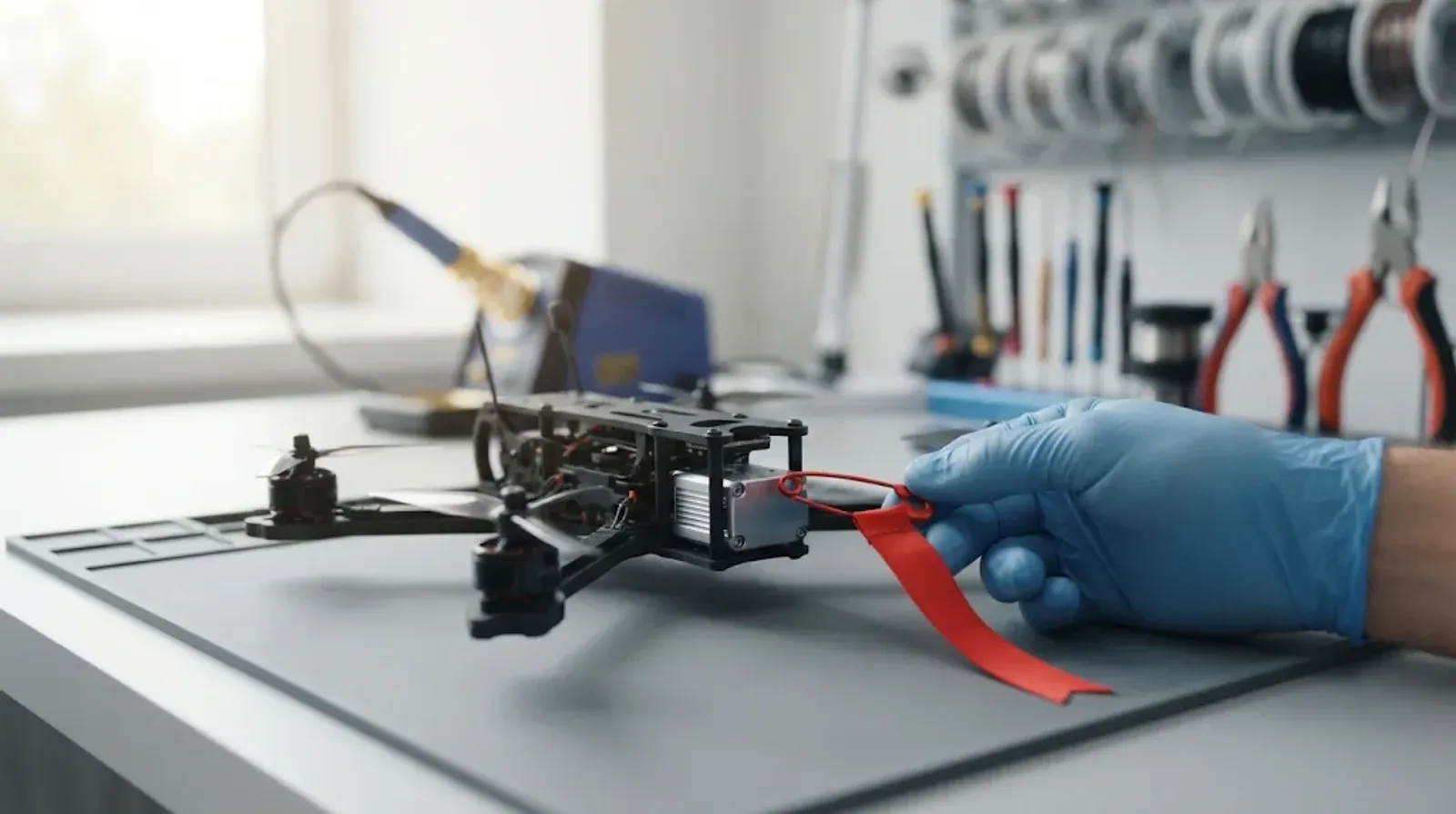
An initiation board is the electronic unit between an interceptor drone’s flight controller and its payload. It keeps the payload safe until the crew arms it and makes it safe again when the drone comes back. In January 2026, Ukraine’s units were receiving more than 1,500 interceptor drones a day, according to the then defence minister Denys Shmyhal. In April his successor, Mykhailo Fedorov, said deliveries in the first four months of the year were already twice the total for 2025. The bottleneck has moved from hardware to people: in January President Zelensky said the number of interceptors had overtaken the number of operators. The electronics on each drone now have to be safe in the hands of a crew trained in weeks.
This article explains what an initiation board does, why safety and recovery now drive its design, and what to ask of one, using the board from Tyko Tech as an example.
Interceptor drones in 2026, in numbers
An interceptor drone, or drone interceptor, is a small, fast uncrewed aircraft that climbs to meet an incoming drone and stops it in the air. In two years it has gone from improvised kits to a product delivered in thousands a day.
| Deliveries to Ukraine’s units | more than 1,500 a day in January 2026 |
| Growth | deliveries in the first four months of 2026 were twice the total for 2025 |
| Germany | funding for 15,000 Ukrainian-made interceptors announced in March 2026, and for tens of thousands more in October |
| Typical price | about $1,000–3,000 for Ukrainian designs, about $15,000 for some Western ones |
| How Ukraine buys them | direct contracts with the Defence Procurement Agency, the Army of Drones Bonus programme and the DOT-Chain Defence marketplace |
NATO countries are now comparing interceptors on price, as Defense News reported in May. For a European buyer, the open question is which interceptors are safe to store, carry, fly and bring back.
What an initiation board does
An interceptor drone carries a payload that must stay inert from the workshop until the moment the crew decides otherwise. The initiation board has three jobs:
- Keep the payload safe in storage, in transport, during preparation and at launch.
- Arm only on the crew’s decision, after a safety delay, and show its state to the operator at every moment.
- Return to safe when a mission is cancelled, when the link is lost or when the drone comes back.
The first and third jobs are where boards differ, and where crews get hurt when a design cuts corners.
Where the board sits in the drone
A typical interceptor has five electronic blocks: the battery and power distribution, the flight controller, the radio receiver, the video transmitter and, on more capable designs, a companion computer that runs on-board AI. The initiation board connects to the flight controller by one or two servo channels and to the payload by its own connector. It has its own battery.
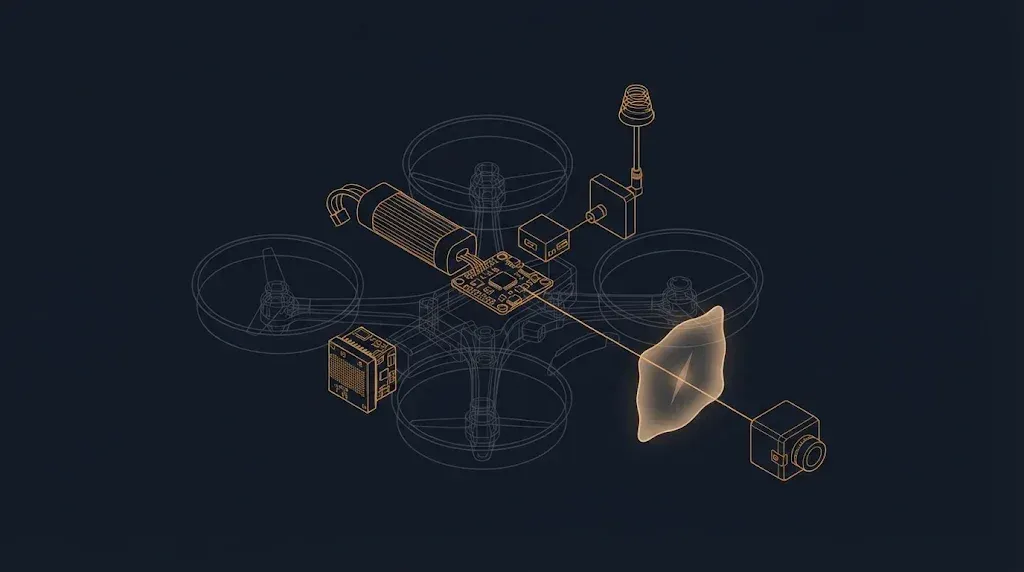
That separation is deliberate. The flight controller decides how the drone flies. The board decides whether the payload is safe. A crash, a reboot or a firmware bug in the flight controller should never change the board’s state on its own.
Why safety and recovery now drive the design
Three changes in 2026 have pushed safety to the top of buyers’ lists.
- Volume and new crews. Interceptors are produced and delivered by the thousand, and new operators are trained quickly. A board that needs an expert to handle it safely does not scale.
- Interceptors that come back. Recovering a drone whose mission was cancelled saves money, even at $1,000–3,000 a drone. It only works if the drone lands and is handled safely with the payload on board, by a crew that may be tired, cold and working at night.
- Codification. In May 2026 Ukraine’s Ministry of Defence explained that an initiation board is a supply item that needs a NATO stock number. It is tested only as part of a codified drone system, and tests on drones that are not codified have no legal force. The maker must supply a passport and an operating manual. Safety now has to be documented as well as designed.
What separates boards is what happens when something goes wrong: a fault in the flight controller, a lost link, a drone caught in a net or a crew member who forgets a step.
The life of an interceptor, from workshop to recovery
The clearest way to judge a board is to follow one drone through its day and ask, at each stage, what keeps the crew safe.
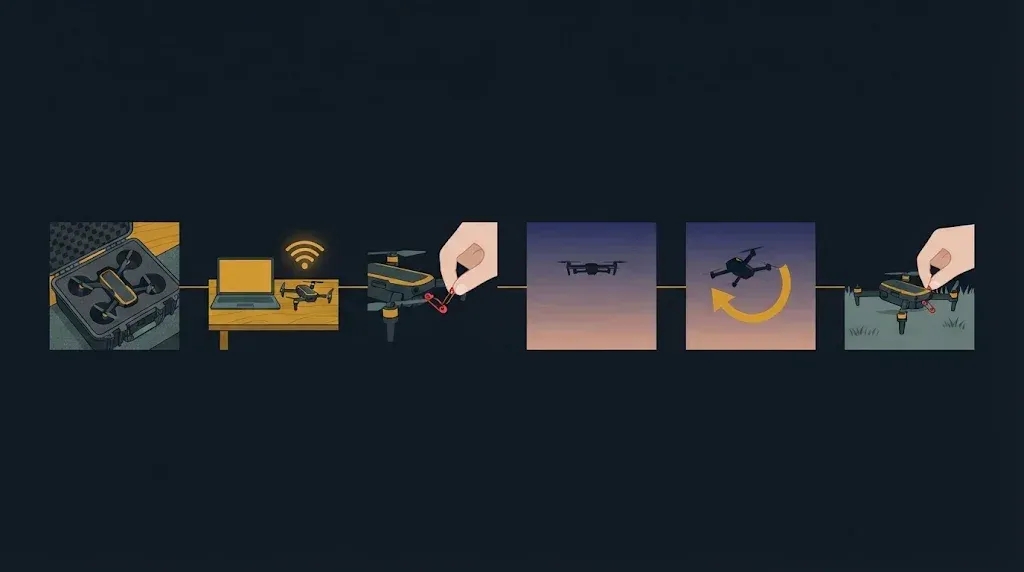
| Stage | What the crew does | What the board should guarantee |
|---|---|---|
| Storage and transport | Drone packed with the safety pin in | Circuit physically broken |
| Preparation | Settings checked over Wi-Fi, flight battery connected | Configuration changes do not arm the board. State visible before launch |
| Launch | Pin removed, drone in the air | Board stays safe until the operator arms it, and then until the arming delay has run |
| Flight | Operator arms the board when the mission requires it | Arming only by command. State shown on the operator’s video |
| Mission cancelled | Operator disarms and flies the drone back | Disarm takes effect at once and is confirmed on screen |
| Recovery | Drone lands, crew inserts the pin | Board returns to its storage state. Timers are reset |
Every stage has a failure case: a lost link, a flat battery, a hard landing. A good board fails towards safe in each of them.
Example: the Tyko Tech board
The board from Tyko Tech is designed around independent safety layers, so that no single fault or wrong command is meant to be enough to arm it. According to the manufacturer’s datasheet:
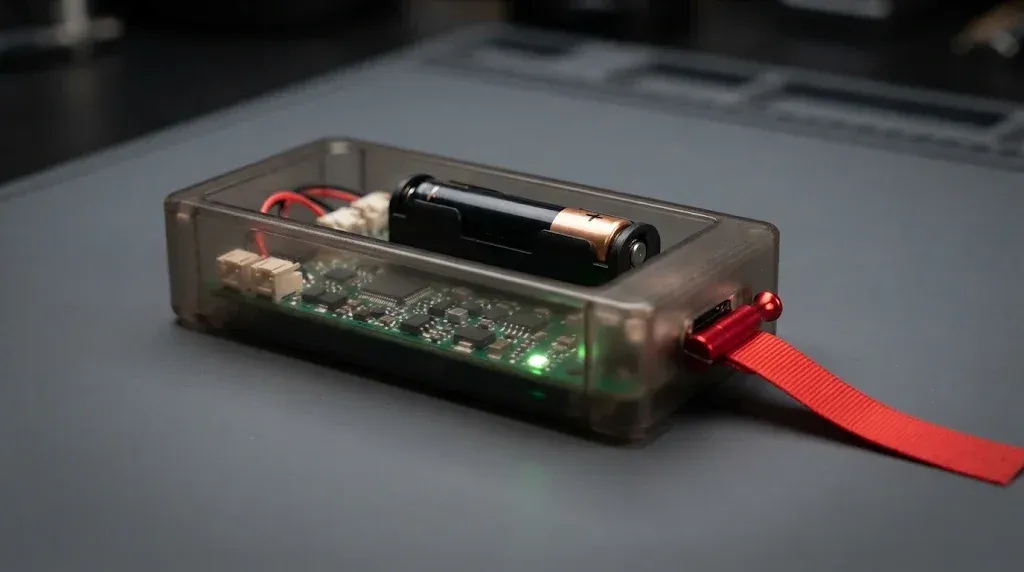
- Mechanical safety pin. While the pin is in, the circuit is physically broken. Inserting the pin shorts the initiator leads and resets all timers.
- Arming delay. A safety timer, 2 minutes by default and adjustable, has to run before the board is live.
- Remote ARM and DISARM. The operator arms and disarms from the remote controller. On DISARM, the board discharges its stored energy to ground and disconnects the initiator circuit.
- Galvanic isolation. The board is galvanically isolated from the flight controller, so faults on the flight controller side are kept away from the payload circuit.
- Over-voltage protection. TVS diodes protect the board from voltage spikes.
- Safe on link loss. If the radio link is lost while the board is disarmed, it stays safe and starts a timed self-disarm.
- Net detection. An accelerometer algorithm tells a catch in protective netting apart from other contact.
The operator sees the board’s state on the video feed through the on-screen display (OSD).
When the mission does not go to plan
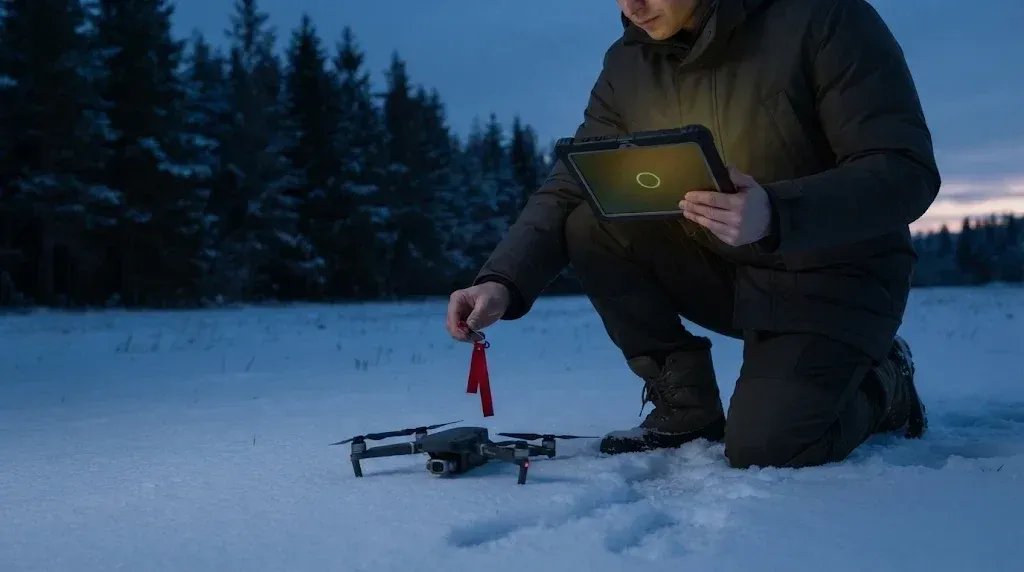
| Situation | What the board does | Result |
|---|---|---|
| Mission cancelled, drone returns | Operator sends DISARM. Stored energy is discharged and the initiator circuit disconnected | Drone lands and is recovered normally |
| Radio link lost while disarmed | Failsafe keeps the board safe and starts a timed self-disarm | Board stays safe |
| Drone forced down | Crew inserts the safety pin. Circuit is broken, leads shorted, timers reset | Board can be removed safely |
| Battery running low | Can be configured to hold the safe state | Operator keeps control |
| Caught in protective netting | Net detection distinguishes the catch from other contact | Lower risk of unintended activation |
Specifications
| Weight | 47 g |
| Dimensions | 100 × 33 × 25 mm |
| Operating temperature | −30 to +50 °C |
| Power | AAA battery |
| Flight controller interface | PWM, 1000 / 1500 / 2000 μs, single or dual servo channel |
| Modes | Controlled by the flight controller, or a fully autonomous mode |
| Status | On-screen display on the operator’s video |
| Configuration | Wi-Fi, with over-the-air firmware updates |
Figures from the manufacturer’s datasheet.
Questions to ask of any initiation board
Whichever board you consider, ask the maker for evidence on these points:
- Independent layers. How many separate conditions must be met before the board is live? Can a single electronic fault, or a single wrong command, arm it?
- Isolation. Is the board electrically isolated from the flight controller? What happens to it when the flight controller reboots or fails?
- Link loss. What does the board do when the radio link drops while it is safe, and while it is armed? Is the behaviour configurable, and who can change it?
- Disarm and recovery. How does the operator know a disarm has worked? How is the board made safe by hand after a forced landing?
- Visibility. Is the state shown on the operator’s screen at every moment, including after a reconnect?
- Configuration security. Who can change settings over Wi-Fi? Is firmware signed? Is there a record of what was changed, when and by whom?
- Environment. Has it been tested across the temperature range, with vibration, humidity and electromagnetic interference from the drone’s own radios?
- Documents. Is there a passport, an operating manual and test evidence on a codified drone? Which safety design standards does the maker reference? US and NATO buyers ask about the safety criteria for arming devices in MIL-STD-1316 and STANAG 4187.
A board whose maker can answer all eight with documents is ready for most of what a codification review and a Western buyer’s due diligence will ask.
Export rules
Boards like this are generally treated as military goods. In the EU they are likely to fall under category ML4 of the Common Military List, which covers devices for arming and initiating payloads. Exporting them, and in many countries brokering them, requires a licence. In Estonia, licences are issued under the Strategic Goods Act. Ukraine adds its own codification requirements for anything its forces buy. Check the classification of a specific product with your licensing authority.
About this article
This article is for information only. It describes a category of drone electronics and the questions buyers ask about it. It is not an offer to sell or supply any product and is not legal advice. Tyko Tech is our partner for drone electronics and UAV platforms; for the aircraft and ground systems we build with partners, see uncrewed systems.
Questions we are asked
What is an interceptor drone?
An interceptor drone, or drone interceptor, is a small, fast uncrewed aircraft that climbs to meet an incoming drone and stops it in the air.
What is an initiation board on an interceptor drone?
It is the electronic unit between the flight controller and the payload. It keeps the payload safe until the crew arms it, makes it safe again on command, and shows its state to the operator.
Why do interceptors that come back need extra safety?
An interceptor whose mission is cancelled has to land and be handled by the crew with its payload on board. The board must return to a safe state on command, and stay safe if the radio link is lost.
How much does an interceptor drone cost?
About $1,000–3,000 for Ukrainian designs and about $15,000 for some Western ones, according to Defense News in May 2026.
Does an initiation board need to be codified in Ukraine?
According to the Ministry of Defence of Ukraine, a board is a supply item that needs a NATO stock number. It is tested as part of a codified drone system, and the maker supplies a passport and an operating manual.
Sources
- Units receive more than 1,500 interceptor drones a day, Shmyhal says (7 January 2026), Ukrainska Pravda
- Ukraine produces up to 1000 interceptors per day, but there are not enough operators – Zelensky (20 January 2026), Liga.net
- Germany funds 15,000 interceptor drones for Ukraine (26 March 2026), The Defense Post
- Germany funds tens of thousands of interceptor drones as Quantum Systems scales in Ukraine (October 2026), Tech.eu
- How to codify an initiation board for a UAS (18 May 2026), Ministry of Defence of Ukraine
- Ukraine doubled all of 2025's interceptor drones in just four months, minister says (28 April 2026), Euromaidan Press
- NATO nations size up an interceptor drone bazaar where low price is everything (5 May 2026), Defense News
- Common Military List of the European Union (2026), Council of the European Union
- Strategic Goods Act, Riigi Teataja (Estonia)
- Tyko Tech, Tyko Tech